考研英语(一)刷题版

选择答案 → 立即反馈 → 查看解析
已做:0 正确:0 正确率:-

Section I Use of English(10分)

Section I Use of English

Directions:

Read the following text. Choose the best word(s) for each numbered blank and mark [A], [B], [C] or [D] on the ANSWER SHEET. (10 points)

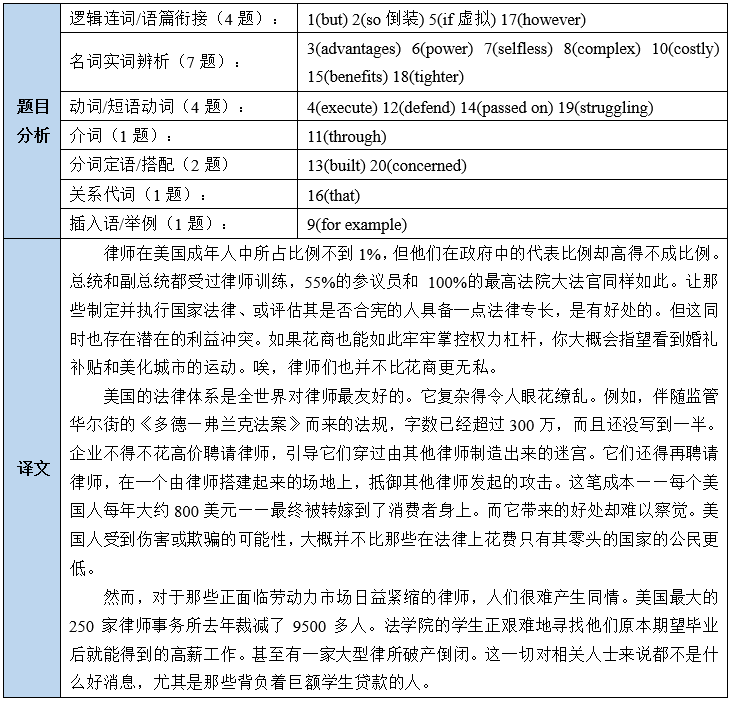
Lawyers are less than 1% of American adults, __1__ they are well-represented in government. Both the president and the vice-president trained as lawyers. __2__ did 55% of senators and 100% of Supreme Court justices. There are __3__ to having a bit of legal expertise among those who write and __4__ the nation’s laws, or assess their constitutionality. But there is also a potential conflict of interest. __5__ florists had such a lock on the levers of __6__, you might expect subsidies for weddings and a campaign to beautify cities. Lawyers, alas, are no more __7__.

The American legal system is the most lawyer-friendly on Earth. It is dizzily __8__. The regulations that accompany the Dodd-Frank law governing Wall Street, __9__, are already more than 3 million words long—and not yet half-written. Companies must hire __10__ lawyers to guide them __11__ a maze created by other lawyers. They must also hire lawyers to __12__ themselves against attacks by other lawyers on a playing field __13__ by lawyers. The cost—roughly $800 a year for every American—is __14__ to consumers. The __15__ are hard to detect. Americans are probably no less likely to be injured or cheated than the citizens of countries __16__ spend a fraction as much.

__17__ it is hard to feel sympathy for lawyers facing a __18__ labour market. America’s 250 biggest law firms shed more than 9,500 people last year. Law students are __19__ to find the lavishly paid work they expected after graduation. One big law firm even went bust. None of this is nice for the people __20__, especially those with large student debts.

1.

考点 考查逻辑连词(转折关系)

详解 空格前指出“律师占美国成年人不到1%”,空格后说“他们在政府中代表比例很高”,前后为“占比极小”与“代表比例极高”的明显反差,构成转折。A项but:意为“但是”,连接对比的两句,准确体现“虽占比小、却代表比例高”的转折逻辑。

B项and:表并列,前后并无并列或递进关系;C项or:表选择,语义不通;D项then:表时间顺承或“那么”,无法体现反差。综上,选A。

2.

考点 “so+助动词+主语”倒装结构(表示“……也如此”)

详解 “so+助动词+主语”倒装结构,表示与前一句情况一致,且前一句为肯定句。前句“总统和副总统都受过律师训练”为肯定句,本句以倒装形式补充“55%参议员和100%最高法院大法官也受过训练”。C项So:So did 55%…即“so+助动词did+主语”倒装,表“55%的参议员也如此”,符合结构与时态。

A项Also:意为“也”,但also不引发主谓倒装,且一般不置于句首接did;B项Nor:意为“也不”,用于否定延续,而前文为肯定,逻辑相反;D项As:意为“正如/因为”,代入语义不通。综上,选C。

3.

考点 名词实词辨析与上下文基调

详解 空格所在句“在那些制定并执行法律的人当中具备一点法律专长是有……的”与下句“但也存在潜在的利益冲突”(But转折)形成利弊对照,故此空应为积极表述,“好处/优势”。B项advantages:意为“优势、好处”,There are advantages to doing sth为固定表达,且与下文conflict of interest构成利弊对照。

A项appeals:意为“吸引力/呼吁/魅力”,侧重主观上的向往或诱惑力,而非客观的实际效用。原文是在客观分析“法律专长”在治理国家中的实际作用,且需与下文的“conflict of interest(利益冲突)”构成严谨的“利vs弊”对冲——appeals强调的是“听起来很诱人”,无法与“客观弊端”形成有效转折,故排除;C项concerns:意为“担忧”,负面,与积极语境相反;D项issues:意为“问题”,负面,不符。综上,选B。

4.

考点 动词辨析(对应立法、行政、司法三权)

详解 空格与write并列,修饰those who write and __4__ the nation’s laws, or assess their constitutionality,恰好对应政府三部门:write(立法者制定)、execute(行政者执行)、assess constitutionality(司法者审查合宪性),根据上下文,此处明确在列举政府的核心职能,因此所选动词必须是一个政府职能动作。D项execute:意为“执行”,write and execute the laws即“制定并执行法律”,与后文assess their constitutionality形成完整三权分工。

A项read:意为“阅读”,不构成与write并列的政府职能;B项break:意为“打破/违反”,语义与制定法律完全相反,排除;C项observe:意为“遵守/观察”,这是普通公民或下级机构的行为,根本不属于政府制定或推行法律的核心职能,与上下文明确指向的政府职能语境直接冲突,排除。综上,选D。

5.

考点 连词(非真实条件句/虚拟语气)

详解 空格后从句谓语用had(过去式),主句用you might expect(might+动词原形),为与现在事实相反的虚拟语气,须If引导。A项If:意为“如果”,引导虚拟条件句,与had/ might的虚拟语气完全一致。

B项Unless:意为“除非”,语义不符;C项When:意为“当……时”,引导真实时间状语,与虚拟语气冲突;D项Where:意为“在……处/哪里”,不引导条件。综上,选A。

6.

考点 固定搭配levers of power

详解 空格与have a lock on(垄断/牢牢掌控)搭配,构成“levers of __6__”,结合上下文假设“如果花商像律师一样垄断了……就能推动婚礼补贴”,此处明确指向“统治国家的政治权力/政权”。因此所选名词必须既契合“政治权力”的语义,又能与levers of构成合理搭配。C项power:意为“权力”,levers of power为英语政治类固定搭配,意为“权力杠杆/掌控政权的手段”,精准对应花商“垄断政权、利用立法谋利”的假设,与全文讨论的“律师在政府中的垄断地位”完美呼应。

A项ability:意为“能力”,侧重个人或组织的内在技能,ability是内在属性,无法被“垄断(lock on)”并用来立法谋利,排除;B项strength:意为“力量/实力”,侧重军事、经济或身体等内在实力,不能准确表达“统治国家的政权”这一政治概念,且levers of strength并非英语惯用搭配,排除;D项force:意为“武力/强制力”,侧重暴力或物理强制(如军队、警察),花商通过“武力杠杆”推动婚礼补贴明显不合逻辑,且levers of force搭配罕见,排除。综上,选C。

7.

考点 形容词辨析与反义类比逻辑

详解 前文用花商作类比:若花商垄断政权(levers of power),会推动婚礼补贴等明显利己的政策,可见花商的行为是出于自身行业利益,而非“无私”地为公众服务。本句“Lawyers, alas, are no more __7__”使用了“no more…than…”的隐含比较结构,完整理解是“Lawyers are no more __7__ than florists (are)”,即“律师和花商一样,都不……”。结合语境,这里要填入的词必须能体现与花商“利己”相对立的品质。B项selfless:意为“无私的”。填入后句意为“律师也并不比花商更无私”,换言之,花商利用权力谋私利,律师同样如此——他们通过制定复杂的法律让全民不得不依赖律师服务(后文提及法律体系的复杂性),本质上也是在为自身行业谋利。no more selfless即指作者对律师群体“假公济私”的讽刺,与花商类比严丝合缝,为正确答案。

A项careless:意为“粗心的”,与利己/无私的讨论完全无关,排除;C项blameless:意为“无可指责的”,侧重道德上没有过错,但前文花商推动补贴只是利己,并非“犯了错”,且全文重点在批判律师的“利益冲突/利己”,而非讨论他们是否“该被指责”,语义焦点不符,排除;D项helpless:意为“无助的”,律师明明垄断了政府权力,绝非“无助”,与事实和语境完全相反,排除。综上,选B。

8.

考点 形容词辨析与下文例证

详解 空格位于“It is dizzily __8__”,后文又说《多德—弗兰克法》监管条文超300万词且未完成一半、法律如“迷宫(maze)”等细节,因此空格处需填入一个形容词,既能与副词dizzily(令人眩晕地)搭配,又能准确概括后文所描述的法律体系“冗长、繁琐、令人晕头转向”的核心特征。A项complex:意为“复杂的”,dizzily complex意为“极其复杂、复杂到令人眩晕”。后文“300万词还没写完一半”“迷宫”正是体系复杂到让人无从下脚的体现,且与全文批判法律体系被律师搞得繁琐冗长、只为律师谋利的负面基调完全一致,为正确答案。

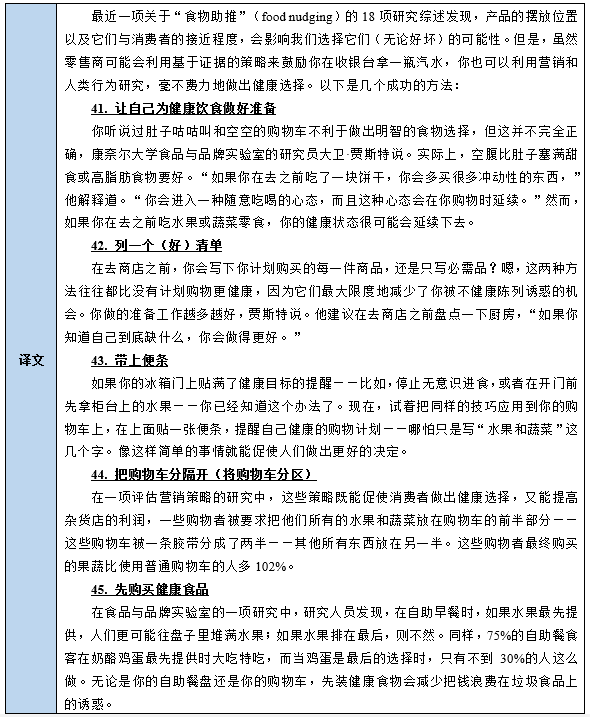
B项comprehensive:意为“全面的、包罗万象的”,侧重范围广、无遗漏,但原文强调的是条文“长、深、绕”(300万词、迷宫),这是结构上的复杂难辨,而非单纯的覆盖全面,且comprehensive多带中性或褒义(如“健全的法律体系”),但全文基调是批判该体系“lawyer-friendly”、故意制造门槛让人依赖律师,dizzily comprehensive无法体现这种“过度、繁琐、令人困扰”的负面批评,排除;C项complementary:意为“补充的”,语义完全无关,排除;D项commercial:意为“商业的”,后文未讨论法律是否以盈利为目的,且无法呼应“迷宫”等线索,排除。

9.

考点 逻辑连接(举例)

详解 本题空格位于后句的主谓之间,作为插入语,其逻辑连接的是前一句的观点“It is dizzily complex”与本句的具体事实“Dodd-Frank regulations are over 3 million words long”。此处空格并非只涉及本句内部逻辑,但实际上这里是用后文来支撑前文的论点,后文“伴随《多德—弗兰克法》的监管条文超300万词且尚未写完一半”是对前文“法律体系极其复杂”的具体例证。D项for example:意为“例如”,引出具体例证,衔接自然。

A项therefore:意为“因此”,表因果,此处非因果;B项however:意为“然而”,表转折,不符;C项namely:意为“即/也就是”,用于等同重述,而此处是举例而非下定义。综上,选D。

10.

考点 形容词辨析与成本主题

详解 前文指出美国法律体系“极其复杂”(dizzily complex)、如“迷宫”(maze),公司必须雇律师来引导,还要雇律师防御其他律师的攻击。这意味着公司对律师服务有极强的、绕不开的刚需,紧接着后文便提到“The cost—roughly $800 a year for every American—is passed on to consumers”,此处的cost正是前文“反复雇用律师”所产生的直接费用,说明雇律师是一笔极其庞大的开支,因此,空格处填入的词必须能体现律师“价格高昂、花费巨大”的特点,才能既解释了为什么会有巨大的cost,又能呼应了后文核心词cost(成本)与passed on to consumers(转嫁给消费者)的主题。C项costly:意为“昂贵的”,costly lawyers呼应后文cost/ passed on to consumers的成本主题。

A项scholarly:意为“学术的”,律师是否学术与法律迷宫、成本花费均无关,排除;B项richly:意为“丰富地”,为副词,不能置于名词lawyers前作定语(“富有的律师”应为rich lawyers),语法错误;D项unfriendly:意为“不友好的”,无关。综上,选C。

11.

考点 介词(穿过迷宫)

详解 空格“guide them __11__ a maze”意为“引导它们___过迷宫”,maze强调从内部穿越。B项through:意为“穿过”,强调从一端到另一端穿越空间或过程,guide sb. through sth.为英语常用搭配,意为“引导某人度过/穿过某事物”,为正确答案。

A项across:意为“横过表面”,如walk across the street,不用于穿越迷宫内部;C项amid:意为“在……之中”,仅表示处于某种环境中,不表示“引导穿越”的动态过程;D项throughout:意为“遍及/贯穿”,强调“在……的整个范围内”或“从头到尾的整个过程(且无处不在)”,填入后guide them throughout a maze意为“引导它们遍及迷宫的每一个角落”,这既不符合公司“寻求合规出路”的商业目的,公司需要的是“穿过”迷宫找到出口,而不是被律师带着在迷宫里“逛遍”每一个角落,故排除。综上,选B。

12.

考点 动词与against的搭配

详解 前文将法律体系比作迷宫,公司雇律师引导穿越;本句递进指出,公司还需雇律师来应对“其他律师的攻击”(attacks by other lawyers),公司是被攻击方,因此空格需填入一个能体现“被动防御、保护自己”的动词,并与后文against构成合理搭配。A项defend:意为“防御”,defend oneself against为固定搭配,契合“免受其他律师攻击”。

B项lean:意为“倚靠”,lean against虽存在但意为“靠在……上”,不表防护;C项fight:意为“战斗”,fight against可表“对抗”,但不如defend精准对应“自我保护、免受攻击”;D项turn:turn against意为“转而反对”,语义相反。综上,选A。

13.

考点 过去分词作后置定语

详解 空格处为过去分词短语作后置定语,修饰“a playing field”(比喻法律博弈的场域/规则环境),需填入一个动词过去分词,描述律师对这个场域施加了什么动作。上文明确提到“a maze created by other lawyers”(由其他律师创造的迷宫),指出繁琐的法律规则体系是律师们“创造、制定”出来的。本句中,公司雇律师是为了在这个场域上“抵御其他律师的攻击”。既然前文的“迷宫”是律师创造的,那么这里的“博弈场域”也理应是律师“搞出来/设立”的。因此,空格处需填入一个与created语义同向、表示“从无到有地创建、构建”的动词过去分词。C项built:意为“构建”,the playing field built by lawyers即“律师制定游戏规则的场域”,呼应前文maze created by other lawyers的“创设”语义,为正确答案。

A项restored:意为“恢复”,不符;B项sustained:意为“维持”,不如built贴合“规则由律师制定”;D项maintained:意为“维护”,侧重维持而非创建。综上,选C。

14.

考点 短语动词

详解 空格所在句的主语是The cost(指代前文公司雇用昂贵律师所产生的费用),宾语是consumers。根据基本商业逻辑,公司产生运营开支后,不会自己完全内部消化,而是会想办法将这笔负担转移给下游。因此,空格处需填入一个由“is+过去分词+to”构成的短语动词,且语义必须体现“将成本转移/转嫁给消费者”这一经济行为。D项passed on:意为“传递、转嫁”,pass on sth. to sb.在经济类文本中是高频搭配,意为“将成本/费用转嫁给某人”,契合“公司把律师费转嫁给消费者”的语境,且passed on to consumers正是英语中表达“转嫁给消费者”的标准说法。

A项handed out:意为“分发、发放”(如发放传单、救济品),填入后表示“成本被分发给消费者”,搭配和语义均不通,排除;B项put away:意为“收起、储存”,填入后表示“成本被收起来给消费者”,逻辑荒谬,排除;C项turned over:意为“移交、翻转”,常指将物品或责任交给另一方(如turn over the keys to sb.),但“成本”不是实物或具体任务,不能“移交给”消费者,排除。综上,选D。

15.

考点 名词辨析(与cost对照)

详解 上句指出法律体系的高昂cost(每人每年约800美元)被转嫁给消费者,这是一笔明面上的、可见的代价,紧接着下句说“Americans are probably no less likely to be injured or cheated than the citizens of countries that spend a fraction as much”(美国人并不比那些在法律上花费少得多的国家的公民更不容易受伤或被骗)。这句话揭示了一个核心事实:花了巨资,但美国人获得的实际保护效果并不比花钱少的国家好,也就是说,这个昂贵体系带来的正面效果微乎其微、几乎看不到,前文的cost(代价)是明确可见的,而下文揭示花了代价却没换来好结果,那么本句说的“难以察觉(hard to detect)”的东西,正是与cost相对的“好处/实际效用”——即花了大钱却看不到的好处。C项benefits:意为“益处”,与cost形成利弊对照,且hard to detect呼应前文体系复杂、好处不明显。

A项drawbacks:意为“弊端”,与cost同向,不构成对照;B项fates:意为“命运”,不符;D项frauds:意为“欺诈”,不符。综上,选C。

16.

考点 关系代词(定语从句)

详解 空格“countries __16__ spend a fraction as much”中__16__引导定语从句修饰countries,且在从句中作主语。B项that:关系代词,指代countries并在从句中作spend的主语,正确。

A项how:意为“如何”,不引导定语从句;C项where:关系副词,在从句中作地点状语,而此处缺主语,若用where须改为where they spend,故不符;D项what:不引导定语从句(用于名词性从句)。综上,选B。

17.

考点 语篇连接副词(转折/话题推进)

详解 上段批评法律体系对消费者代价高昂、益处难寻;本段转向律师自身的困境(裁员、求职难、破产),语势转折,作者的态度是“很难感到同情”,因此,空格需要一个表转折的逻辑词,来连接“前文的批判/律师的获利背景”与“本句的否定同情态度”,形成“虽然(前文铺垫了律师的种种不是/虽然现在律师有困难),但是(很难同情他们)”的转折关系。因此要用However承上启下。A项However:意为“然而”,表转折,连接“体系问题”与“律师个体困境”的对照。

B项Though:意为“尽管”,作句首连词须引出主句,此处为独立句,用法不当;C项Instead:意为“反而/取而代之”,无前文可替代对象;D项So:意为“因此”,表因果,此处为转折而非因果。综上,选A。

18.

考点 形容词比较级(劳动力市场)

详解 后文“大律所裁员9500人”“学生难觅高薪工作”“一家律所破产”均说明律师就业市场收紧、严峻。C项tighter:意为“更紧/更严峻”,a tight labour market即“紧缩的劳动力市场”,契合裁员与求职困难的语境。

A项more flexible:意为“更灵活”,与裁员背景相反;B项looser:意为“更宽松”,相反;D项stronger:意为“更强”,不形容labour market的困难程度。综上,选C。

19.

考点 动词辨析(现在分词作谓语)与语境基调

详解 本段首句(第17题)点明律师面临“更紧张的劳动力市场(tighter labour market)”,后文接连给出负面事实——250家大律所裁员超9500人、一家大所甚至破产(went bust)。这构建了一个明确的行业萧条、就业极度困难的背景。法学生原本期待(expected)毕业后能获得“高薪工作(lavishly paid work)”,但在行业寒冬下,这种期待显然落空。因此,空格需填入一个动词,体现法学生在客观困境中努力寻找出路,但过程极其艰难、结果不容乐观的状态。D项struggling:意为“挣扎着/艰难地”,struggle to find准确刻画求职之难。

A项attempting:意为“尝试”,attempt to do偏中性,完全不携带“困难、挣扎”的负面色彩,无法呼应前文的萧条背景,排除;B项willing:意为“愿意”,be willing to强调主观意愿。但语境强调的是客观上“找不找得到”的难题,而非主观上“愿不愿意”找,且willing与“裁员、破产”的客观困境无逻辑关联,排除;C项managing:manage to do通常隐含“成功克服困难”的积极结果,句意会变为“法学生设法找到了高薪工作”,这与本段“就业难、裁员、破产”的负面语境直接矛盾,排除。综上,选D。

20.

考点 形容词后置定语

详解 本段描述律师行业面临的严峻困境——大所裁员超9500人、法学生找不到预期的高薪工作、甚至有大型律所破产。末句“None of this is nice for the people 20”中的“this”指代前文所有负面现象(裁员、失业、破产),“None of this is nice”意为“这一切对……的人来说都不是好事”。因此,空格处需填入一个词,修饰“the people”,指代“受这些行业困境影响、涉及其中的人”。A项concerned:意为“有关的”,the people concerned为固定搭配,指“相关人士”,正确。

B项confused:意为“困惑的”,不符;C项connected:意为“连接的”,不如concerned贴切;D项confined:意为“受限的”,不符。综上,选A。

Reading Comprehension Part A · Passage 1(10分)

Section II Reading Comprehension

Part A

Directions:

Read the following four texts. Answer the questions below each text by choosing [A], [B], [C] or [D]. Mark your answers on the ANSWER SHEET. (40 points)


Text 1

Men are generally better than women on tests of spatial ability, such as mentally rotating an object through three dimensions or finding their way around in a new environment. But a new study suggests that under some circumstances a woman’s way of navigating is probably more efficient.

Luis Pacheco-Cobos of the National Autonomous University of Mexico and his colleagues discovered this by following mushroom gatherers from a village in the state of Tlaxcala for two rainy seasons. Two researchers, each fitted with GPS navigation devices and heart-rate monitors, followed different gatherers on different days. They recorded the weight of the mushrooms each gatherer collected and where they visited. The GPS data allowed a map to be made of the routes taken and the heart-rate measurements provided an estimate of the amount of energy expended during their travels.

The results, to be published in Evolution and Human Behaviour, show that the men and women collected on average about the same weight of mushrooms. But the men travelled farther, climbed higher and used a lot more energy—70% more than the women. The men did not move any faster, but they searched for spots with lots of mushrooms. The women made many more stops, apparently satisfied with, or perhaps better at finding, patches of fewer mushrooms.

Previous work has shown that men tend to navigate by creating mental maps of a territory and then imagining their position on the maps. Women are more likely to remember their routes using landmarks. The study lends support to the idea that male and female navigational skills were honed differently by evolution for different tasks. Modern-day hunter-gatherers divide labor, so that men tend to do more hunting and women more gathering. It seems likely that early humans did much the same thing.

The theory is that the male strategy is the most useful for hunting prey; chasing an antelope, say, would mean running a long way over a winding route. But having killed his prey, the hunter would want to make a beeline for home rather than retrace his steps exactly. Women, by contrast, would be better off remembering landmarks and retracing the paths to the most productive patches of plants.

The research suggests that in certain circumstances women are better at navigating than men, which might lend some comfort to a man desperately searching for an item in a supermarket while his exasperated wife methodically moves around the aisles filling the shopping trolley. He is simply not cut out for the job, evolutionarily speaking.

21. It can be inferred from Paragraph 1 that the new study _____.

第一段只有两句,句1讲男性在空间能力测试上普遍优于女性,such as后举例可直接跳过,句2以But转折引出新研究,指出某些情况下女性导航方式可能更高效。新发现直接反驳了首句的普遍认知,构成了对传统观点的挑战。选项A中,conventional view和male spatial superiority分别同义替换首句的男性优势描述,challenges精准对应But的转折逻辑,是对第一段整体关系的准确概括,因此选A。

B项与原文直接相反,新研究恰恰指出女性更高效,而非确认男性更好,且all为绝对词,考研中此类含绝对化词汇的选项常为干扰项。C项张冠李戴,心理旋转是首句传统观点的举例内容,并非新研究焦点,新研究实际聚焦的是女性导航方式。D项含always和proves等绝对词,原文对应表述为under some circumstances和probably,D项把可能变为确定,把某些情况扩大为所有情况,偷换概念且与原文严重不符。

22. GPS navigation devices and heart-rate monitors were chosen for the research most probably because they can _____.

根据“GPS navigation devices、heart-rate monitors”定位到第二段末句,GPS数据可绘制行进路线,心率测量可估算能量消耗。前3句讲谁跟着谁、记录数据等信息可全部跳过。and连接两个并列,GPS管路线,心率管能耗,找选项必须同时覆盖这两个信息。选项A中,yield data on同义替换原文allowed a map to be made和provided an estimate(产生/提供数据);paths taken替换routes taken(行进路径);calories burned替换energy expended(消耗的能量)。三个核心信息均完成同义替换,精准概括设备功能,因此选A。

B项张冠李戴,原文记录蘑菇重量的是研究者(They),而非GPS或心率设备,且each gatherer被偷换为overall。C项无中生有,原文心率设备只估算了energy,完全没有提及time。D项曲解文意,原文是GPS数据让研究者绘制地图,并非设备直接把地图提供给采集者,动作对象和动作本身均被偷换。

23. The result of the experiment indicated that women gatherers _____.

第三段数据对比是核心,前两句给出结果:男女采集蘑菇平均重量相同,但男性走得更远、爬得更高、多消耗70%能量,且移动速度并未更快;女性停留次数更多,对较少蘑菇的斑块感到满意或更擅长寻找。即相同收获下,女性行进距离更短、能耗更低,说明其行进方式更高效。选项D travelled more efficiently是对这一数据对比的精准概括,且直接呼应第一段提出的“女性导航方式更高效”的假设,因此选D。

A项无中生有,原文只比较了能量消耗(energy expended),从未提及如何恢复能量(regain energy)。B项张冠李戴,记住地标(remembering landmarks)是第四段关于男女导航方式差异的理论解释,并非第三段实验结果直接表明的内容,属于跨段偷换。C项以偏概全,原文为apparently satisfied with…patches of fewer mushrooms,且后接or perhaps better at finding,说明这只是作者的一种推测,并非实验明确指出的确定结论,且easily content简化了原文的限定条件,不能概括实验核心发现。

24. By referring to evolution, the author intends to show that _____.

根据evolution定位到第四段核心句,问写作目的。原文提到,研究支持了“男女导航技能在进化过程中因不同任务而被不同地磨砺”这一观点。后文现代和早期人类分工都是举例可跳。for different tasks对应男女任务不同即狩猎和采集。选项B中,the sexes同义替换male and female;evolved distinct navigational strategies精准对应navigational skills were honed differently by evolution;suited to different tasks复现for different tasks,完整概括了进化理论要说明的核心:男女进化出了适应各自任务的导航策略,因此选B。

A项答非所问,只是重复第一段现象,未回答引用进化理论的目的,排除。C项无中生有,后半句are no longer used today与原文现代人类依然存在男猎女采分工(Modern-day hunter-gatherers divide labor)直接矛盾。D项曲解文意,consciously decided将原文It seems likely that early humans did much the same thing推测性的“可能做了同样的事”偷换为主动决定,且未触及进化与导航技能的关系。

25. We can infer from the supermarket scene depicted in the last paragraph that man _____.

根据“supermarket”定位到最后一段,超市场景描述可略读,直接定位末句总结“He is simply not cut out for the job, evolutionarily speaking”,结合前文可知the job指代searching for an item in a supermarket(在超市找商品)。即从进化角度看,男人根本不是干这活的料。选项B中,may not be the right type同义替换not cut out for(不是合适人选),finding items直接对应searching for an item,may对应推断题的委婉语气,与原文evolutionarily speaking的推测口吻一致,因此选B。

A项无中生有且含绝对词,原文desperately searching意为“拼命寻找”,不能推出“总是没耐心(always impatient)”。C项与原文直接相反,末句明确说男人not cut out for the job(不适合),而非suitable(适合)。D项偷换概念,利用文章主题词navigate误导,但超市场景的具体行为是“找商品(finding items)”,并非广义的“正确导航(navigate correctly)”,且原文强调的是“不适合干这活”而非“偶尔导航出错”,属于用主题词偷换具体动作。

Reading Comprehension Part A · Passage 2(10分)

Text 2

The realization that colds can kill has renewed interest in finding vaccines and treatments. The trouble is that the common cold is caused not by one virus but by hundreds of different ones. This means a vaccine or drug that works against one of these viruses, or one family of viruses, is usually ineffective against all the others. What’s more, because colds are usually so mild, if treatments cause even minor side effects they can be worse than the disease. Such treatments will never get approval for general use, which is why most companies instead focus on drugs that relieve symptoms.

Nevertheless, some drugs and vaccines are being developed against the cold viruses most likely to turn nasty. A vaccine against Respiratory Syncytial Virus (RSV), a virus which can cause serious illness in young children and the elderly, is going through clinical trials. It consists of a weakened strain of the virus given as a nasal spray.

A treatment for RSV infections, based on RNA interference, is also in development. However, treatments for specific viruses are useless unless your cold is caused by the virus in question—and doctors have no quick way to work out which virus is to blame for a cold. Systems to do this are under development, mostly based on looking for specific DNA or RNA sequences, but none are near to reaching the market.

An alternative approach would be to keep taking drugs that prevent infection throughout the cold season, such as a derivative of the anti-smallpox drug cidofovir which has been shown to combat adenoviruses, viruses that can cause upper respiratory infections. But again, as adenoviruses are only responsible for a few percent of colds, the benefits hardly justify the expense and risk of side effects from remaining on a drug permanently.

Short of everyone on the planet isolating themselves for two or three weeks, so existing cold viruses run out of hosts and die out, it is hard to see how we can ever defeat the common cold. Even then, new cold viruses would evolve in time from animal viruses. Some even question whether it is desirable to try to eliminate colds. “It’s blind speculation,” says Joel Weinstock of Tufts University in the US, “but the common cold may protect us from more serious viruses.” An occasional sniffle might be a price worth paying if it keeps our immune defenses primed.

26. The drugs against colds are usually ineffective because _____.

根据题干“drugs against colds are usually ineffective”定位到第一段第三句“This means a vaccine or drug that works against one of these viruses…is usually ineffective against all the others.”前两句讲感冒病毒种类多,可跳过细节直接抓因果关系。This means指代前一句,所以回看第二句“The trouble is that the common cold is caused not by one virus but by hundreds of different ones.”not…but…强调重点在hundreds of different ones,句意为“感冒由数百种病毒引起,因此针对一种病毒的药对其他病毒无效”,所以无效的原因在于“导致感冒的病毒实在太多”。选项D中,hundreds of viruses对应原文hundreds of different ones,can lead to colds对应原文caused by,概括了药物无效的根本原因,因此选D。

A项因果混淆,colds are usually not serious对应第四句colds are usually so mild,但这是because引导的副作用的原因,而非药物无效的原因。B项答非所问,drugs can only relieve the illness对应末句relieve symptoms,这是药物无效的结果而非原因。C项张冠李戴,drugs against some viruses have side effects对应第四句side effects,与无效无直接因果。

27. The phrase “turn nasty” (Paragraph 2) most probably means that the cold viruses could be _____.

根据题干“turn nasty”定位到第二段首句“some drugs and vaccines are being developed against the cold viruses most likely to turn nasty”,分析句子语法可知most likely to turn nasty是作后置定语修饰cold viruses,表明这些病毒具有某种倾向。下一句紧接首句,提到一种针对RSV病毒的疫苗,RSV正是句首“最可能turn nasty的感冒病毒”的具体代表。接着用同位语“a virus which can cause serious illness in young children and the elderly”解释说明RSV病毒,这种病毒会导致严重疾病。即turn nasty是指病毒会变得危险且严重。选项C中,dangerous and severe同义替换原文serious illness,对应举例中病毒导致严重疾病的描述,因此选C。

A项无中生有,unpleasant and disgusting未在原文找到对应,且未体现serious的程度。B项曲解文意,fruitless and disappointing与病毒致病性无关,完全偏离上下文。D项偷换概念,ineffective and painful,ineffective是前文讲的药物无效,painful原文未提及,均非turn nasty的含义。

28. It could be inferred from the third paragraph that _____.

根据题干定位到第三段。However转折后指出:针对特定病毒的治疗除非感冒正是由该病毒引起的,否则毫无用处,而医生目前没有快速方法确定是哪种病毒。紧接着说检测系统正在开发中,但没有一个接近进入市场。将这两层信息串联:精准治疗的前提是确定病毒→确定病毒目前没有快速方法,且相关系统短期内也不会上市→因此,依赖病毒鉴定的定制化治疗目前实际上无法落地。选项C中,tailored treatments for specific cold viruses同义替换原文treatments for specific viruses;remain impractical at present对应“医生没快速方法+系统未接近上市”共同指向的现状——即精准治疗暂时行不通,因此选C。

A项与原文直接相反,原文明确说none are near to reaching the market(没有一个接近进入市场),A将其偷换为will soon be available(很快可用),反向干扰。B项无中生有且程度绝对,原文提到寻找DNA/ RNA序列是正在开发的系统所基于的手段,但从未评价其为most reliable(最可靠)。D项与原文直接相反,原文说doctors have no quick way to work out which virus is to blame,D说能quickly identify,与原文no quick way完全矛盾。

29. Taking preventive drugs throughout the cold season _____.

根据题干定位到第四段。原文指出,腺病毒只导致感冒的百分之几(only responsible for a few percent of colds),因此持续服药的好处很难证明“费用和风险是合理的”(the benefits hardly justify the expense and risk of side effects)。选项B中,limited effectiveness同义替换adenoviruses are only responsible for a few percent of colds(有效性有限,因为只对极少数感冒有用);may not be worthwhile对应benefits hardly justify(好处抵不上代价,即不值得);given引导原因状语,概括原文的因果逻辑。但从“好处难抵费用和风险”可推出“可能不值得”,因此选B。

A项与原文直接相反,原文说好处很难证明费用合理(hardly justify the expense),A将其偷换为cost-effective(划算),且most colds与原文few percent矛盾。C项无中生有且过度推断,原文说该药物可对抗腺病毒(combat adenoviruses),并未说能completely cure(完全治愈),且prevent变为cure,偷换概念。D项无中生有,原文第一段提到大多数公司转而研发缓解症状的药物(focus on drugs that relieve symptoms),并未说长期预防药物已被广泛采用,且widely adopted与benefits hardly justify的负面评价矛盾。

30. Which of the following would be the best title for the text?.

全文围绕“能否及是否应该消灭感冒”展开。前四段讲消灭感冒的困难:病毒种类多导致药物无效(第1段)、疫苗和针对性治疗进展有限(第2~3段)、长期服药成本效益比低(第4段)→说明消灭感冒不可能/不现实。最后一段进一步指出:即使隔离也难根除,且消灭感冒可能失去其保护我们免受更严重病毒的作用→说明消灭感冒可能不必要甚至有风险。选项A中,impossible概括了前四段“病毒多、无特效药、系统未上市、长期服药不划算”的层层论证;unnecessary概括了最后一段Weinstock提出的“感冒可能保护我们”的观点。全文核心线索正是“为什么消灭感冒既不可行也未必可取”,因此选A。

B项以偏概全,疫苗研发仅在第二段提及,且原文指出大多数公司转向缓解症状药物,疫苗并非全文主线,更谈不上revolutionizing。C项以偏概全,感冒的“好处”仅在最后一段Weinstock的推测中出现,且作者强调这是blind speculation,不能代表全文主旨。D项无中生有,原文虽提到进化(evolution)和动物病毒,但只是最后一段的补充说明,并非贯穿全文的核心话题。

Reading Comprehension Part A · Passage 3(10分)

Text 3

A gulf has existed between humanists and technologists for a long time. In the 1950s, C. P. Snow described the humanistic and scientific communities as tribes losing contact with each other: Literary people were missing the essential insights of the laws of thermodynamics, and scientific people were ignoring the glories of Shakespeare and Dickens. The wide gap that Snow identified has only deepened. In the modern tech world, the value of a humanistic education shows up in evidence of its absence. The extraordinary ignorance on questions of society and history displayed by the men and women reshaping society and history has been the defining feature of the social‑media era.

But the case for the value of humanities in a technologically determined world has been made before. Steve Jobs always credited a significant part of Apple’s success to his time as a dropout hanger‑on at Reed College, where he fooled around with Shakespeare and modern dance, along with the famous calligraphy class that provided the aesthetic basis for the Mac’s design. “A lot of people in our industry haven’t had very diverse experiences. So they don’t have enough dots to connect, and they end up with very linear solutions without a broad perspective on the problem,” Jobs said. “The broader one’s understanding of the human experience, the better design we will have.”

Despite the clear value of a humanistic education, its decline continues. Over the past 10 years, STEM (science, technology, engineering and mathematics) has triumphed, and the humanities have collapsed. The number of students enrolled in computer science is now nearly the same as the number of students enrolled in all of the humanities combined.

And yet, despite the drastic divide of the moment, natural‑language processing is going to force engineers and humanists together. They are going to need each other despite everything. Computer scientists will require basic, systematic education in general humanism: The philosophy of language, sociology, history, and ethics are not amusing questions of theoretical speculation anymore. They will be essential in determining the ethical and creative use of chatbots. The humanists will need to understand natural‑language processing because it’s the future of language, but also because there is more than just the possibility of disruption here. Natural‑language processing can throw light on a huge number of scholarly problems. It is going to clarify matters of attribution and literary dating that no system ever devised will approach; natural language processing is much more sophisticated than the current systems used to determine which plays Shakespeare wrote.

The connection between humanism and technology will require people and institutions with a breadth of vision and a commitment to interests that transcend their field. Before that space for collaboration can exist, both sides will have to take the most difficult leaps for highly educated people: Understand that they need the other side, and admit their basic ignorance. But that’s always been the beginning of wisdom, no matter what technological era we happen to inhabit.

31. The gulf between humanism and technology _____.

根据题干“The gulf between humanism and technology”定位到第一段。第一段指出鸿沟长期存在。第二句讲1950s Snow觉得人文与科技群体之间失去了联系,举例细节部分(thermodynamics、Shakespeare)可跳过。第三句“The wide gap that Snow identified has only deepened.”是核心句,deepened表明鸿沟在加深,only强调了“只会加深、不会缩小”的语气。后文用“In the modern tech world…”引出现代目前的状况。此处出现考研常见的时间对比信号:1950s代表过去,modern tech world/ social-media era代表现在,暗示鸿沟在时间线上发生了变化。核心句到这里都是顺承的关系,即第四、五句具体说明第三句,介绍这一鸿沟在现代科技时代进一步加深的表现,根据“the social-media era”也可进一步确定时间是在现代科技时代中。选项B中,widened同义替换deepened(变宽/加深),in the modern tech era对应原文In the modern tech world和social-media era的时间背景,句意与选项完全匹配,因此选B。

A项与原文直接相反,首先原文明确说Snow描述过鸿沟且“has only deepened”(只会加深),并非“largely been ignored”(很大程度上被忽视),若鸿沟被忽视则应缩小而非加深,再者首段首句已交代“鸿沟早已存在”,证明鸿沟早就被发现,且1950s还有专家描述这个鸿沟是指人文与科技群体之间失去了联系,即当时也有人在研究,因此并无忽略可言,排除。C项无中生有,原文从未提及“education reforms”(教育改革),尤其是reform完全是属于凭空添加。D项偷换概念,利用原文“social-media era”设障,但原文是说“科技界人士对社会历史问题的无知是社交媒体时代的特征”,此句描述的是“特征”,而非鸿沟“引发了社交媒体上的辩论(sparked debates on social media)”,debates无从谈及,属于用原文词汇误导。

32. Which of the following best represents Steve Jobs’ view?.

根据题干“Steve Job’s view”定位到第二段。本段以Steve Jobs为例论证人文教育的价值。前两句讲Jobs将Apple成功归功于大学时期的人文学习经历(Shakespeare、modern dance、calligraphy),举例细节可跳过。核心在后面Jobs的原话:“A lot of people…haven’t had very diverse experiences. So they don’t have enough dots to connect, and they end up with very linear solutions without a broad perspective on the problem.(行业里的人缺乏多样化的经历,因此没有足够的‘点’可以连接,最终只能给出缺乏广阔视野的线性方案)”。此处出现为例子服务于论点,Jobs的话强调diverse experiences和broad perspective才能避免linear solutions,即人文体验能拓宽视野,后句“The broader one’s understanding of the human experience, the better design we will have(对人文体验的理解越广,设计就越好)”进一步总结,即乔布斯认为,人文学科很重要,因为它有助于丰富经历、拓宽视野,从而设计出成功的产品。选项C中,essential对应原文significant part和better design的隐含逻辑,expanding horizons同义替换broad perspective和broader understanding of the human experience,因此选C。

A项无中生有,原文只说Jobs在Reed College的经历,并未将college泛化为“nurturing grounds for versatile talents”(培养多面手的摇篮),versatile原文未提,乔布斯的经历是为了强调“人文学科的重要性”而不是“大学教育的重要性”。B项与原文直接相反,原文指出industry的人缺乏diverse experiences导致linear solutions,说明仅有技术技能不够,B项却说“掌握技术技能是成功的关键”,与Jobs强调人文拓宽视野的态度相悖。D项偷换概念,用原文“dots to connect”设障,但dots指的是个人积累的diverse experiences(不同领域知识的连接),而非“multi-person cooperation”(多人合作),属于用原文词汇误导。

33. The author thinks that engineers need an education in humanism to _____.

根据题干“engineers need an education in humanism to”定位到第四段。第三句指出Computer scientists将需要humanism教育:“The philosophy of language, sociology, history, and ethics…will be essential in determining the ethical and creative use of chatbots.(……伦理学……对于确保聊天机器人被创造性地、伦理地使用至关重要)”为“列举+总结+应用场景”行文结构。而ethics则是列举项之一,紧接着用essential总结,并给出具体应用场景“ethical and creative use of chatbots”(聊天机器人的伦理和创造性使用)。即工程师需要人文学科中的伦理学,是为了在开发产品(如chatbots)时做出符合伦理的决策,也就是把伦理考量融入产品设计中,这正是人文学科教育对工程师的核心价值所在。选项D中,incorporate ethics into their product design同义替换determining the ethical use of chatbots,product design对应chatbots的开发设计,句意与选项完全匹配,因此选D。

A项的importance、teamwork可定位到第四段第一、二句(together、need each other)和第四句(essential),选项利用essential及表示“合作”的together、need each other杂糅干扰,将原文“自然语言处理的发展会迫使工程专家与人文学者携手起来”篡改为“接受人文教育会使工程专家认识到团队合作的重要性”,原文实际未提及teamwork(团队合作),属于凭空添加。B项偷换概念+与原文态度相悖,原文说人文学科(包括ethics)“不再是理论推测的消遣(not amusing questions of theoretical speculation anymore)”,紧接着强调它们“对决定聊天机器人的伦理使用至关重要”,即原文的核心态度是人文学科要走出纯理论空想,落实到实际应用(产品设计中的伦理决策),B项却说需要人文学科教育是为了“提升理论推理能力(improve their theoretical reasoning ability)”,将原文强调的“实际应用”又拉回了“理论”层面,与原文从理论走向应用的逻辑完全相悖,且theoretical reasoning在原文中从未作为正面目标出现,属于凭空添加。C项与原文直接相反,原文明确说“not amusing questions”,即人文学科不再是“有趣的消遣”,C项却说“bring amusement带来乐趣”,与原文态度完全相悖,排除。

34. Natural‑language processing can help humanists _____.

根据题干“Natural-language processing can help humanists”定位到第四段后半部分。本段后半部分讲Natural-language processing对人文学者的价值:“Natural-language processing can throw light on a huge number of scholarly problems. It is going to clarify matters of attribution and literary dating that no system ever devised will approach; natural language processing is much more sophisticated than the current systems used to determine which plays Shakespeare wrote.”(Natural-language processing能为大量学术问题提供启发,尤其是能澄清归属和文学断代问题——它比当前用于确定莎士比亚所写剧本的系统更为精密)。通过throw light on scholarly problems总起,attribution、literary dating及determine which plays Shakespeare wrote为具体分述。即Natural-language processing能帮人文学者解决的一个核心学术问题,是确定文本的作者归属。选项A中,determine the author of a text同义替换attribution和determine which plays Shakespeare wrote,句意匹配,因此选A。

B项无中生有,根据predict、languages可得知来源于第四段第五句(the future of language),选项将“自然语言处理本身是语言的未来”扭曲为“自然语言处理可以预测语言的未来演变”,原文并未提及“predict the evolution of languages”(预测语言进化)。C项无中生有,原文说的是clarify matters of attribution(澄清归属问题),而非identify errors in scholarly articles(识别学术文章错误),errors完全凭空添加。D项偷换概念,原文throw light on的对象是scholarly problems,具体指attribution(确定作者),D项替换为“interpret literary works in a new light”(以新视角解读文学作品),将“确定作者归属”偷换为“解读作品内容”。

35. To make a collaboration work, humanists and technologists need to _____.

根据题干“To make a collaboration work, humanists and technologists need to”定位到第五段。本段前半部分讲合作需要的条件:“Before that space for collaboration can exist, both sides will have to take the most difficult leaps for highly educated people: Understand that they need the other side, and admit their basic ignorance.(在合作空间形成之前,双方必须迈出最难的一步——理解自己需要对方,并承认自身的基本无知)”。冒号前说“the most difficult leaps”(最难的一步),冒号后具体说明这一步是什么——承认无知。即要让合作成立,双方必须承认自己对对方领域的基本无知。选项C中,admit their ignorance about each other’s field同义替换admit their basic ignorance(结合前文humanists and technologists的语境,ignorance指对彼此领域的无知),句意与选项完全匹配,因此选C。

A项无中生有,原文未提及stereotypes(刻板印象),只提到要承认无知(admit ignorance),无知是指“我不知道你在干嘛,我不懂你的领域”,“消除刻板印象”是指“我之前对你有错误的固定看法,现在不这么认为了”,因此A属于凭空添加。B项偷换概念,原文说“commitment to interests that transcend their field”(致力于超越自身领域的利益),B项替换为“common interests and visions”(共同利益和愿景),将“超越自身领域”偷换为“共同拥有”,与原文逻辑不符。D项无中生有,原文未提及criticisms(批评),属于利用合作语境编造的干扰项。

Reading Comprehension Part A · Passage 4(10分)

Text 4

In 2011, Rupert Murdoch announced the beginning of a “new digital renaissance” for news. The newspaper giant was launching an iPad‑inspired publication called The Daily. Chasing tech’s distribution and cash, news firms strike deals to try to ride out the digital wave. They make concessions to platforms that attempt to take all of the audience (and trust) that great journalism attracts, without ever having to do the complicated and expensive work of the journalism itself.

Publishers like News Corp did it with Apple and the iPad, investing huge sums in flashy content that didn’t make them any money but helped Apple sell more hardware. They took payouts from Google to offer their journalism for free through search, only to find that it eroded their subscription businesses. They lined up to produce original video shows for Facebook and to reformat their articles to work well in its new app. Then the social‑media company canceled the shows and the app. Many news organizations went out of business.

Now publishers are deep in negotiations with tech firms such as OpenAI to sell their journalism as training for the companies’ models. That media companies would rush to do these deals after being so burned by their tech deals of the past is extraordinarily distressing. And these AI partnerships are far worse for publishers. They are using AI to disrupt internet search—to help users find a single answer faster than browsing a few links. So why would anyone want to read a bunch of news articles when an AI could give them the answer, maybe with a tiny footnote crediting the publisher that no user will ever click on?

Tech companies act in their interest. Ask six publishers how they should be paid by these tech companies, and they will spout off six different ideas. One common idea publishers describe is getting a slice of the tech companies’ revenue based on the percentage of the total training data their publications represent. That’s impossible to track, and there’s no way tech companies would agree to it. Even if they did agree to it, there would be no way to check their calculations.

The news industry finds itself in this dangerous spot, yet again, in part because it lacks a long‑term focus and strategic patience. Many large media companies are run by executives who want to live to see another quarter, not set up their companies for the next 50 years. At the same time, the industry’s lobbying power is eroding. Tech companies clearly have far more influence than media companies.

The long‑term solutions are far from clear. But the answer to this moment is painfully obvious. Publishers should be patient and refrain from licensing away their content for relative pennies. They should protect the value of their work, and their archives. They should have the integrity to say no. It’s simply too early to get into bed with the companies that have no compelling case for how they will help build the news business.

36. By striking deals with tech platforms, publishers like News Corp _____.

根据题干publishers like News Corp定位到第二段。本段以新闻集团为例,论证出版商与科技平台合作的结果。Apple、Google、Facebook等具体公司名为举例细节,可跳读,重点抓合作结果的并列汇总。首句指出:Publishers like News Corp did it with Apple and the iPad, investing huge sums in flashy content that didn’t make them any money(新闻集团押注苹果和iPad,投入巨资做花哨内容,但没赚到钱)。后文用三家公司的具体遭遇展开:从Google “eroded their subscription businesses”(侵蚀订阅业务),到Facebook “canceled the shows and the app”(取消节目和应用),再到末句“Many news organizations went out of business”(许多新闻机构倒闭)都可得知合作结果是出版商与科技平台合作的结果是投入无回报、业务受损、甚至倒闭,由此可推理得知一连串操作下来,出版商遭受了重大损失,对应A项“suffered heavy losses”(遭受重大损失)来进行总结概括。

B项的betrayed audience trust(背叛读者信任)文中未直接提及,文中说的是attempt to take all of the audience (and trust) that great journalism attracts(平台抢走受众和信任),不是出版商背叛;C项simplified their work(简化工作)与文意相反,首段末句提到“…without ever having to do the complicated and expensive work of the journalism itself科技平台不必参与新闻业复杂且昂贵的工作(即出版机构的工作并未被分担/简化)”,将“平台不干活”偷换为“出版商工作变简单”,且出版机构实际上是做了更复杂、更花哨的内容(investing huge sums in flashy content);D项survived the digital wave(挺过数字浪潮)与事实相反,文中明确说了“Many news organizations went out of business”(许多新闻机构倒闭了)。

37. What would happen if publishers partnered with AI companies?.

根据题干定位到第三段。本段前面讲出版商急着和AI公司做交易,作者认为这比之前的交易更糟(far worse),因为AI会颠覆搜索……这些背景信息可跳读,重点抓末句的结论性问句。末句:“So why would anyone want to read a bunch of news articles when an AI could give them the answer, maybe with a tiny footnote crediting the publisher that no user will ever click on?”(既然AI能给出答案,也许还带一个注明出处的小脚注,但没有用户会去点,那为什么还会有人想读一堆新闻文章呢?),即AI会直接给答案,用户根本不需要点开去看新闻原文。由此推理:如果出版商和AI公司合作,结果就是没人会花时间读新闻文章了。由此对应B项“Nobody would spend time reading news articles”这个结论。

A项think critically(批判性思考)文中完全没提,原文是说“人们不用阅读新闻就能通过AI快速得知答案”,强调的是“AI更快捷得知结果”,不是“批判性”的问题;C项说人们会unconsciously click on links(无意识点击链接),与原文“no user will ever click on”(没人会点)直接相反;D项question the credibility(质疑可信度)原文未涉及,文中的credit是由其本义“归功于”引申出“标明(出处或来源)”的意思,不是选项中的credibility “可信度”。

*网络上帖子里写的“cr.”就是此处credit的用法,表“标注素材来源”。

38. The author implies in Paragraph 4 that it would be impossible for publishers to _____.

根据题干impossible定位到第四段第四句,根据句首的That回指的功能,要回顾前文内容。本段先指出科技公司按自身利益行事,接着介绍出版商的分钱想法:按自家内容占AI总训练数据的比例从科技公司收入中抽成。第四、五句论证这个想法不现实:“That’s impossible to track, and there’s no way tech companies would agree to it. Even if they did agree to it, there would be no way to check their calculations.”[这无法追踪,科技公司不可能同意(它们会更偏向自身利益),即便同意也没法核查他们的计算(无法得知利益分配是否公平)],即数据占比无法追踪、公司不会同意、查不了账。由此推理出版商根本拿不到预期中的报酬,这正对应D项receive the expected payment from tech companies(无法从科技公司获得预期报酬)的推断。

A项由第四段第二句six publishers…six different ideas(六个出版商有六个不同想法)进行臆断,但这只是说出版商内部想法不一致,并未提及“集体谈判”可行性,更非impossible所指;B项干扰来自impossible to track,但原文无法追踪的是“数据占比”,B偷换为“新闻被如何利用”,属于细节偷换;C项利用no way to check their calculations干扰,但原文是无法核查“数据占比的计算the percentage of the total training data their publications represent”,C偷换为“训练成本的计算training costs”。

39. The news industry finds itself in a dangerous situation partly due to _____.

根据题干dangerous定位到第五段首句。本段分析新闻业陷入危险的原因:in part because it lacks a long-term focus and strategic patience.(部分原因在于缺乏长远目光和战略耐心),后文是对第一句的展开说明,高管只想活过下个季度,不为未来50年打算,进一步印证“缺乏长远目光”,由此直接对应B项short-sightedness(目光短浅)。

A项funding shortage是利用前文内容“新闻业想要争取科技平台的资金,但结果损失惨重”以及第五段第二句的want to live to see another quarter捏造出“新闻业因资金短缺而面临生存困境”,但这并非文中所述原因,故排除;C项利用了第五段第二句的run by executives who…进行干扰,将“管理人员缺乏长远眼光”篡改成“管理人员不严格/管理松散”,本段说的是战略眼光问题;D项poor lobbying strategies出现在第三句,但题干问的是in part because明确指向的主因(第一句),D是At the same time引出的并列次要问题,非题干所问,且“游说力量薄弱”≠“游说策略糟糕”。

40. The author suggests that publishers should _____.

根据题干定位到最后一段。本段作者直接给出对出版商的建议,重点抓三个should。第一,要有耐心,别以极低价把内容授权出去(be patient and refrain from licensing away their content for relative pennies);第二,要保护自身作品和档案的价值(protect the value of their work, and their archives);第三,要有底气说“不”(have the integrity to say no)。三个建议的核心主旨是让出版商守住底线、不贱卖内容、保护自身价值。看选项,C项preserve the value of journalism正是对第二个建议protect the value of their work的同义替换,准确概括了作者的核心主张。

A项form long-term partnerships with tech,与原文末尾“It’s simply too early to get into bed with the companies…”(现在就和这些公司捆绑为时过早)直接相反;B项license away at a fair price,偷换概念。原文确实提到了别贱卖(for relative pennies),但这只是作者建议的一个方面;紧接着作者说了protect the value(保护价值)、say no(拒绝),最后一句更是明确总结“It’s simply too early…(现在就和这些公司捆绑为时过早,因为它们根本拿不出帮助新闻业发展的有力理由)”,可见作者的核心立场是现阶段根本不该和AI公司做交易,而不仅仅是“价格太低不行”,B项把作者的态度曲解成“只是定价问题,公平价格就可以卖”,忽略了作者“保护价值、时机未到、不该绑定”的根本态度,属于把“不该卖”偷换成了“可以卖但要价合理”;D项seek outside help in business growth,与作者主张相悖且文中无据。最后一段作者呼吁出版商“保护自身价值”、“拒绝授权”,并指出科技公司“拿不出帮助新闻业务的理由”,可见作者认为答案在于守住自身底线而非向外求助;第五段也指出问题根源是内部“缺乏长远目光”,应对之策是内部调整(高管应着眼50年而非一个季度)。D项不仅将外部对象美化为“可求助的帮助者”,更与作者“不该和科技公司捆绑”的立场冲突,属于无中生有。

Part B 匹配小标题(10分)

Part B

Directions:

Read the following text and answer the questions by choosing the most suitable subheading from the list A-G for each of the numbered paragraphs (41-45). There are two extra subheadings which you do not need to use. Mark your answers on the ANSWER SHEET. (10 points)


[A] Bring a visual reminder

[B] Eat nothing before shopping

[C] Prime yourself for healthy eating

[D] Use a half-sized cart

[E] Section off your cart

[F] Shop healthy first

[G] Make a (good) list

A recent review of 18 studies on “food nudging” finds that the placement of products and their nearness to consumers influences the likelihood we’ll choose them—for better or worse. But while retailers may use evidence-based strategies to encourage you to grab, say, a soda at the checkout counter, you, too, can use marketing and human behavior research to make healthy choices without much effort. Here are several ways to succeed:

41.________________________

You’ve heard that a rumbling stomach and an empty grocery cart are not good for making smart food choices, but that’s not entirely true, says David Just, a researcher at Cornell University’s Food and Brand Lab. In reality, an empty stomach is better than one stuffed with sweets or fatty foods. “If you eat a cookie right before you go, you’re going to buy a lot more impulsive stuff,” he explains. “You get in the mindset of eating frivolously, and it carries over as you shop.” If you snack on fruits or vegetables before your trip, however, your healthy streak will likely carry on.

42.________________________

Before you go to the shop, do you write down every item you plan to purchase or just the necessities? Well, both methods tend to be healthier than shopping without a plan, since they minimize the chances you’ll be tempted by unhealthy displays. The more prep work you can do, the better, says Just. He suggests taking stock of your kitchen before hitting the store, “If you know what you’re actually out of, you do a much better job.”

43.________________________

If your refrigerator door is plastered with reminders of your health goals—say, to stop mindlessly eating or to reach for the fruit on the counter before opening the door—you already know the drill. Now, try applying that same technique to your grocery cart by taping a note to it that reminds you of your healthy shopping plan—even if it’s just writing the words “fruits and veggies.” Something as simple as that can prompt people to make better decisions.

44.________________________

In research evaluating marketing tactics that could sway consumers to make healthy choices while also improving grocery stores’ bottom line, some shoppers were instructed to put all their fruits and vegetables in the front half of their grocery carts—which were divided by a strip of duct tape—and everything else in the other half. Those shoppers ended up purchasing 102 percent more fruits and vegetables than those with normal carts.

45.________________________

In one study from the Food and Brand Lab, researchers found that people at a breakfast buffet were more likely to pile their plates with fruit when it was offered first compared to when it was last in line. Likewise, 75 percent of buffet-goers loaded up on cheesy eggs when they were presented first, while fewer than 30 percent of them did so when eggs were their last choice. Whether it’s your buffet plate or your grocery cart, loading up on healthy foods first will reduce temptation to waste money on junk food.

41.

【篇章理解】本段引用康奈尔大学的研究人员的话去证明在购物之前消费者进食的食物类型会影响其后的购物倾向,因此健康饮食有利于健康购物。

【正确选择】本段主要说的是在购物前应该要怎样做,因此可以将答案初步锁定在有before shopping的B和有Prime yourself的C上。本段引用专家David Just的话,讨论购物前吃东西对购物选择的影响。前两句是背景引入,可跳读,重点抓第三句之后的对比逻辑。核心句意:空腹比吃甜食或高脂肪食物好,因为吃甜食会让你进入“随意吃”的心态(mindset of eating frivolously),而如果在购物前吃水果或蔬菜,健康习惯则会延续(healthy streak will likely carry on)。由此推理:本段的核心建议是“在购物前通过选择正确的食物,让自己提前进入健康饮食的心态”。C项Prime yourself for healthy eating(让自己为健康饮食做好准备/进入状态)正是对这一核心动作的概括,prime yourself对应get in the mindset和healthy streak will carry on。

【干扰项排除】原文明确说an empty stomach is better than one stuffed with sweets(空腹比吃甜食好),且后文说吃水果更好,并非建议“什么都不吃”。B项把“空腹比吃甜食好”偷换成了“应该空腹/不吃任何东西”,与原文直接相反。

42.

【篇章理解】本段首句提出一个疑问,消费者购物前是会列出所有要买的商品清单还是只是列出必需品。进而认同无论是列出哪种情况,列清单这种做法都有利于健康购物。最后本段引用研究员给出的建议论述这种做法的好处。

【正确选择】本段讨论购物前的计划。首句以问句引出“列清单”的话题,后面给出结论:无论列所有物品还是只列必需品,两种方法都比没计划健康,因为减少了被不健康陈列诱惑的机会。后文Just进一步建议“去商店前盘点厨房缺什么”。句意核心:购物前做计划、列清单能让人做出更好的选择,减少冲动购买。G项Make a (good) list(列一个好清单)直接对应本段核心动作write down every item和plan,是对段落主旨的准确概括。故确定本题选G。

【干扰项排除】其余选项均不涉及“列清单/提前计划”这一核心动作,属于无中生有或偏离主题。

43.

【篇章理解】本段首句通过日常生活中在冰箱门贴提醒便条的习惯做法,引出本段的建议:消费者要学会写一个小纸条来提醒自己的健康购物计划。

【正确选择】本段前半部分讲冰箱上贴健康目标提醒是已知技巧(you already know the drill),后半部分用“Now, try applying that same technique to your grocery cart”引出核心建议:把同样的技巧用在购物车上——贴一张便条提醒自己健康购物计划,哪怕只是写“水果和蔬菜”。句意核心:把视觉提醒的技巧从冰箱转移到购物车上,通过贴便条这个视觉提示来促使自己做出更好决策。A项Bring a visual reminder(带来一个视觉提醒)精准对应taping a note to it和reminds you of your healthy shopping plan,是对本段建议的准确概括。

44.

【篇章理解】本段主要介绍了一项研究,说明把购物车分成两部分有利于消费者做出健康的购物选择。

【正确选择】cart“购物车”是本段的关键词,据此可将答案初步锁定D和E上。本段介绍了一个研究,重点抓研究的核心操作而非数据细节。研究人员让参与者把蔬果放在购物车的前半部分——用胶带分成两半(divided by a strip of duct tape),其他东西放另一半。句意核心:用胶带把购物车内部空间一分为二,强制前半放健康食物,以此来助推健康选择。E项Section off your cart(把购物车分隔开)中的section off完美对应原文的divided by a strip of duct tape,准确表达了“用隔断分区”的动作。

【干扰项排除】排除D项Use a half-sized cart,原文是“把正常购物车分成两半”,购物车尺寸没变,只是内部被胶带分区了;D项暗示的是“使用半个大小的购物车”(车体本身尺寸减半),属于偷换概念,把“空间对半分”变成了“车体尺寸减半”。

45.

【篇章理解】本段首先介绍的是一项发现,食物摆放的顺序也会影响到消费者的购买选择。接着建议消费者购物时要首先购满健康食材,这才能少花费钱买垃圾食品。

【正确选择】本段先用自助餐研究举例:先提供的食物更容易被选择(水果先提供就被多拿,奶酪鸡蛋先提供也被多拿)。末句总结:“Whether it’s your buffet plate or your grocery cart, loading up on healthy foods first will reduce temptation to waste money on junk food.”(无论是自助餐盘还是购物车,先装健康食物能减少买垃圾食品的诱惑。)句意核心:先选/先放健康食物是做出健康选择的关键。F项Shop healthy first(先买健康食物)直接对应末句总结的loading up on healthy foods first,是对段落主旨的精准提炼。

Part C 英译汉(10分)

Part C

Directions:

Read the following text carefully and then translate the underlined segments into Chinese. Your translation should be written neatly on the ANSWER SHEET. (10 points)


How many Facebook friends do you have? For some, the answer can be a signal of social success, and the numbers claimed can be enormous: Facebook permits 5,000 of them (though these might include products and companies as well as people). But Robin Dunbar, a psychologist at Oxford University, has long reckoned that claims of vast numbers of Facebook friends do not say much about actual human relationships.

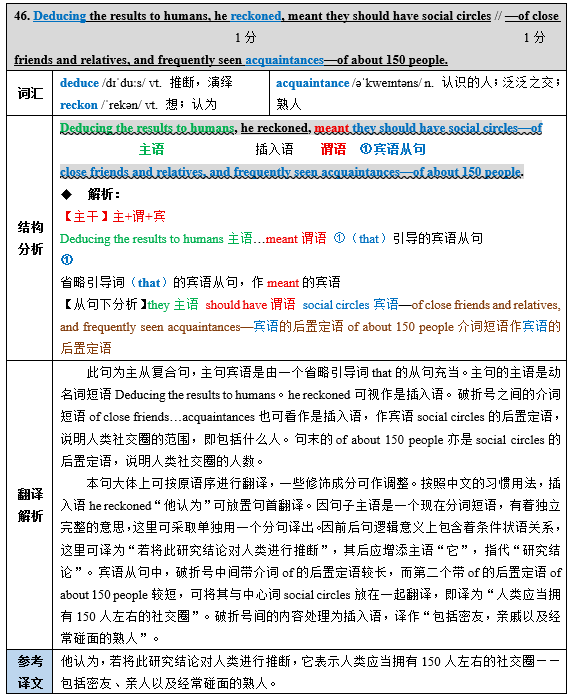
Dr. Dunbar is the originator of Dunbar’s number, a rough measure of the number of stable relationships that individuals can maintain. He found a correlation between the average size of each species’s neocortex (a recently evolved part of the brain) and that of their social groups. [46] Deducing the results to humans, he reckoned, meant they should have social circles—of close friends and relatives, and frequently seen acquaintances—of about 150 people.

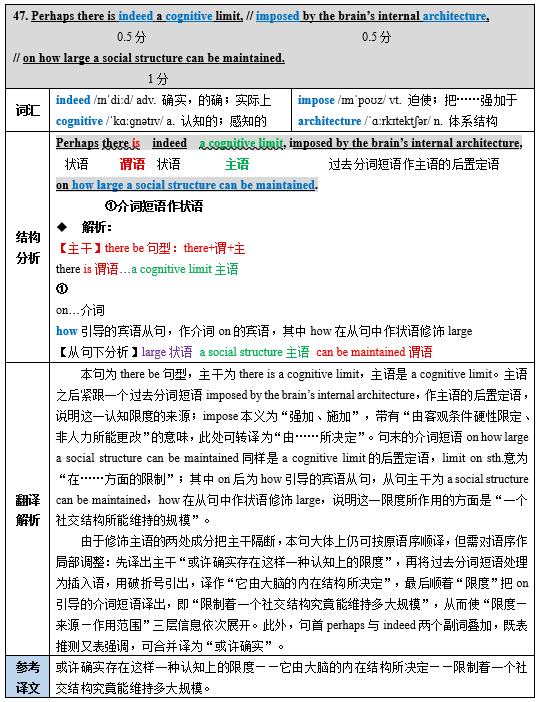
Things have changed a bit since Neolithic and Roman times, though, and many wonder what effects modern technology might have on the size of such circles. [47] Perhaps there is indeed a cognitive limit, imposed by the brain’s internal architecture, on how large a social structure can be maintained. But there may also be another limit: time. Maintaining 150 friendships face-to-face consumes a lot of that. Gathering together many times online, though, is an easy thing.

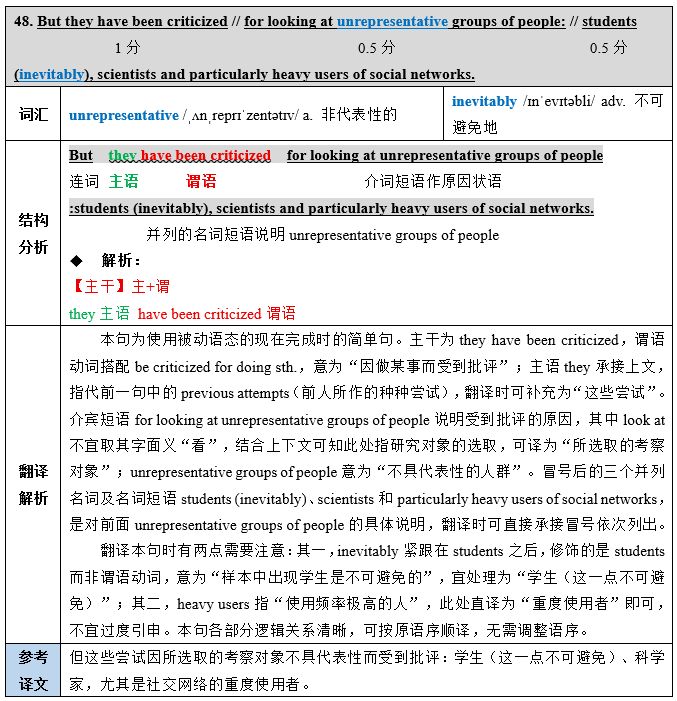
Previous attempts to decide between these possibilities have tended to come down on the cognitive-limit side of the fence. [48] But they have been criticized for looking at unrepresentative groups of people: students (inevitably), scientists and particularly heavy users of social networks. The latest try, in which Dr. Dunbar carried out a survey organized by a biscuit-maker, has overcome that. It is the first national-scale, randomly sampled study to investigate the matter.

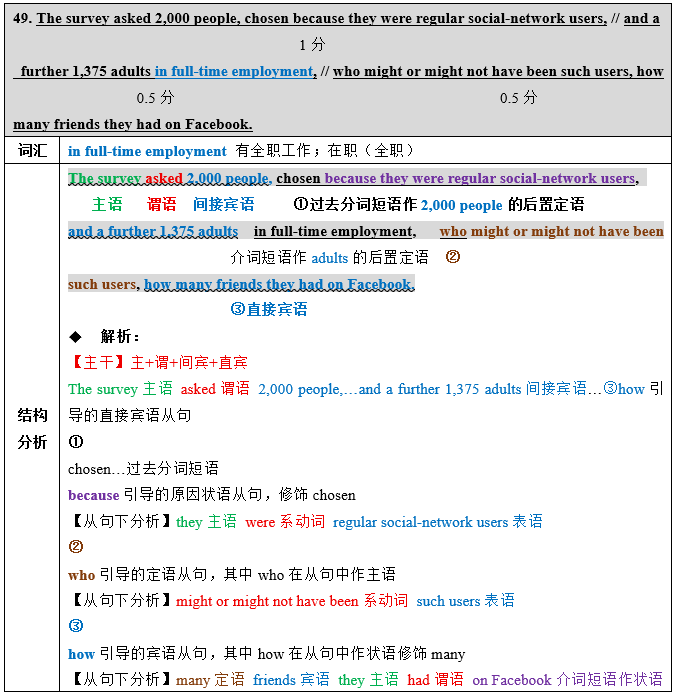
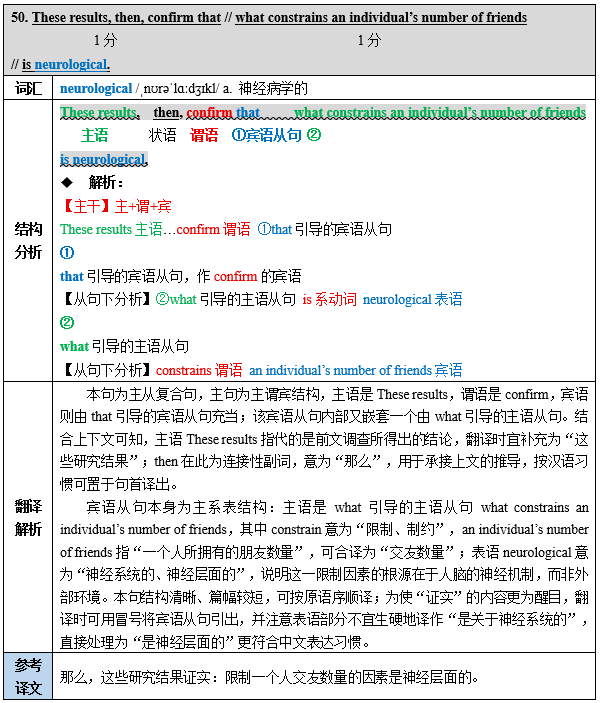
[49] The survey asked 2,000 people, chosen because they were regular social-network users, and a further 1,375 adults in full-time employment, who might or might not have been such users, how many friends they had on Facebook. The results showed, to no surprise whatsoever on the part of Dr. Dunbar, that the average number in the two groups were Dunbar-sized numbers: 155 and (when those who did not use Facebook at all were excluded) 187, respectively.

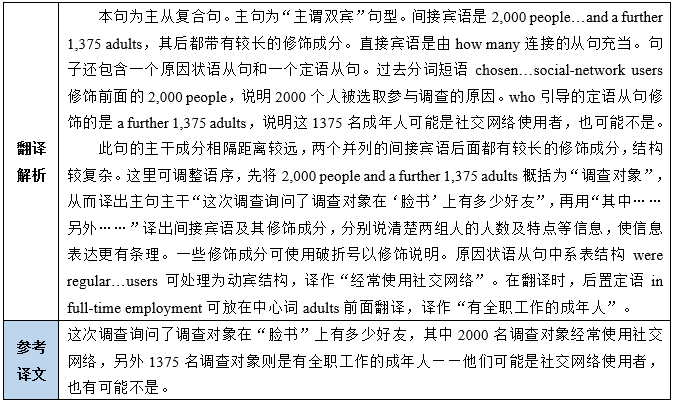
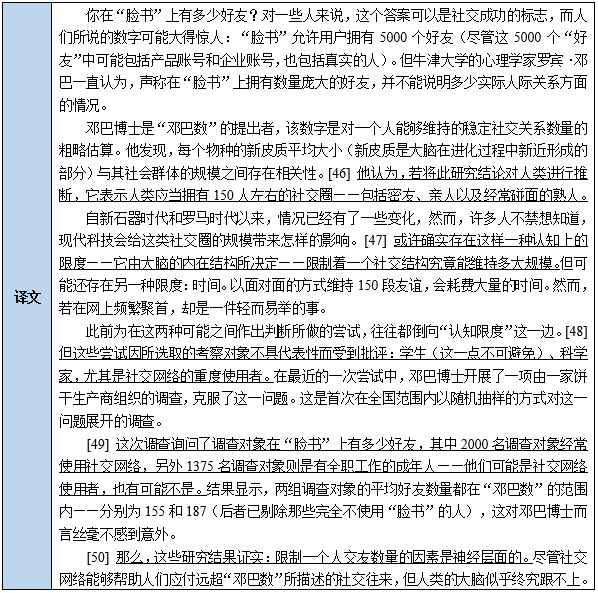
[50] These results, then, confirm that what constrains an individual’s number of friends is neurological. Even though social networks could help people handle far more social interactions than Dunbar’s number describes, it seems the human brain simply cannot keep up.

46.

请在下方尝试翻译,完成后点击查看参考译文:

参考译文:他认为,若将此研究结论对人类进行推断,它表示人类应当拥有150人左右的社交圈——包括密友、亲人以及经常碰面的熟人。

47.

请在下方尝试翻译,完成后点击查看参考译文:

参考译文:或许确实存在这样一种认知上的限度——它由大脑的内在结构所决定——限制着一个社交结构究竟能维持多大规模。

48.

请在下方尝试翻译,完成后点击查看参考译文:

参考译文:但这些尝试因所选取的考察对象不具代表性而受到批评:学生(这一点不可避免)、科学家,尤其是社交网络的重度使用者。

49.

请在下方尝试翻译,完成后点击查看参考译文:

参考译文:这次调查询问了调查对象在“脸书”上有多少好友,其中2000名调查对象经常使用社交网络,另外1375名调查对象则是有全职工作的成年人——他们可能是社交网络使用者,也有可能不是。

50.

请在下方尝试翻译,完成后点击查看参考译文:

参考译文:那么,这些研究结果证实:限制一个人交友数量的因素是神经层面的。

Section III Writing

Part A 应用文(10分)

Section III Writing

Part A

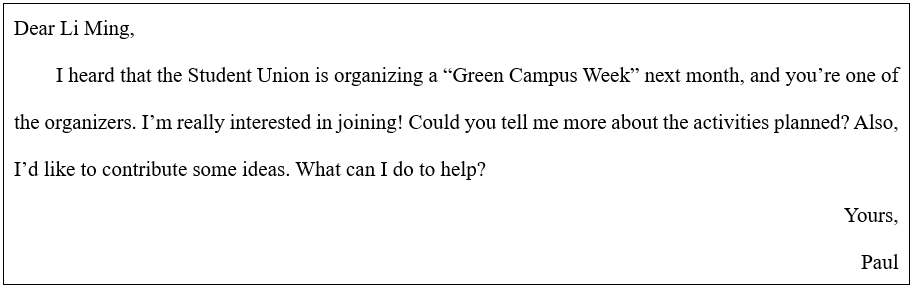
51. Directions:

Read the following email from your classmate Paul and write him a reply.

Write your answer in about 100 words on the ANSWER SHEET.

Do not use your own name in the email; use “Li Ming” instead. (10 points)

题目要求:阅读同学 Paul 的邮件,写一封约 100 词的回信。署名使用 “Li Ming”。(原题含邮件图片)

Part B 短文写作(20分)

Part B

52. Directions:

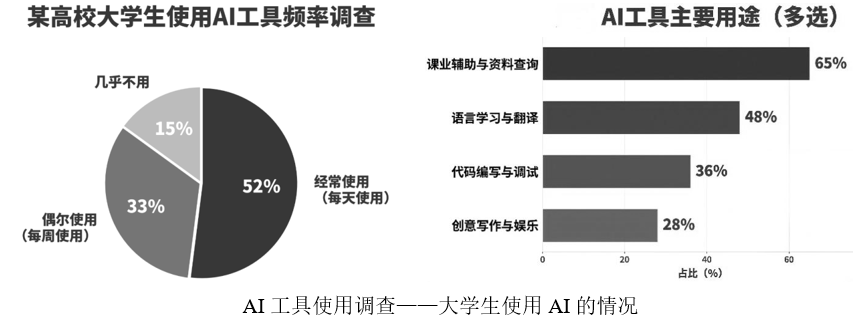
Write an essay of 160-200 words based on the charts below. In your essay, you should

1) describe the charts briefly,

2) interpret the implied meaning, and

3) give your comments

Write your answer in 160-200 words on the ANSWER SHEET. (20 points)

题目要求:根据图表写一篇 160–200 词短文:1) 简要描述图表;2) 解释隐含意义;3) 给出你的评论。(原题含图表)